


Radiolarite
Another red rock. Does it also contain iron?
Yes – it doesn’t take a lot of iron to colour a rock red.
Radiolarite is a special kind of rock. Its secret is not visible at first sight.
It came into being at around 5000 metres below sea level, on the sea floor, and is made of skeletons of radiolarians.
Radiolarians?
They are microscopic little animals – protozoans – that still live in cool oceans today.
Their skeleton is not made of limestone, like most animals, but of silica or opal – which is chemically the same as glass.
Opal – glass – animal skeletons – my word. How does that come to be?
When the radiolarians die, their glassy skeletons slowly fall to the seabed. They form a radiolarian ooze.
Over time this radiolarian ooze has been consolidated into radiolarite rock.
Below 4500 meters, the acid-sensitive calcareous shells of other animals dissolve. Only the glassy skeletons of the radiolarians remain. Thus, radiolarite also tells us something about the depth of the sea at that time.
Rocks certainly hide a lot of secrets!
Radiolarite is hard, and so wasoften used during the StoneAge to make tools.
In the National Park, it has a prominent place below the Piz d’Esan high above the Val Trupchun. A side valley is even named after it. Val Cotschna means as much as red valley.
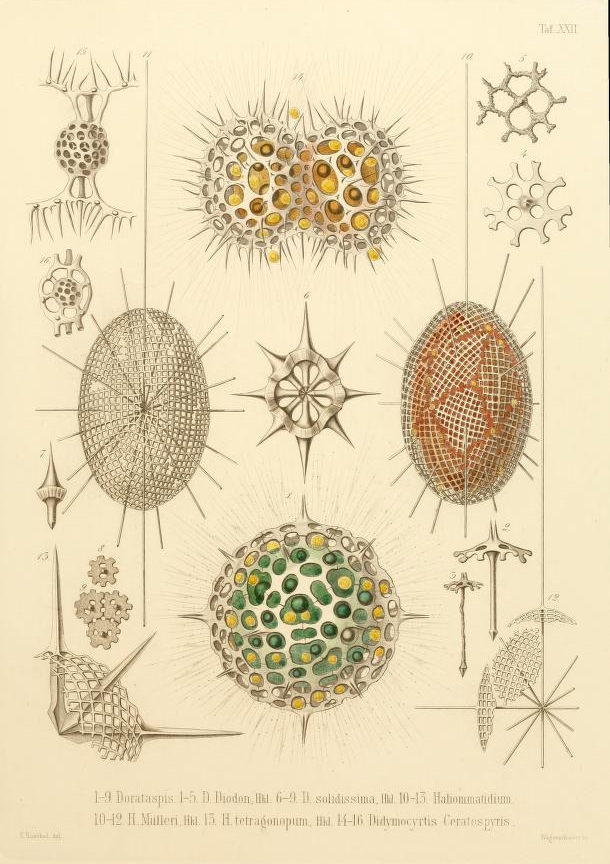
Drawings by Ernst Haeckel 1862


