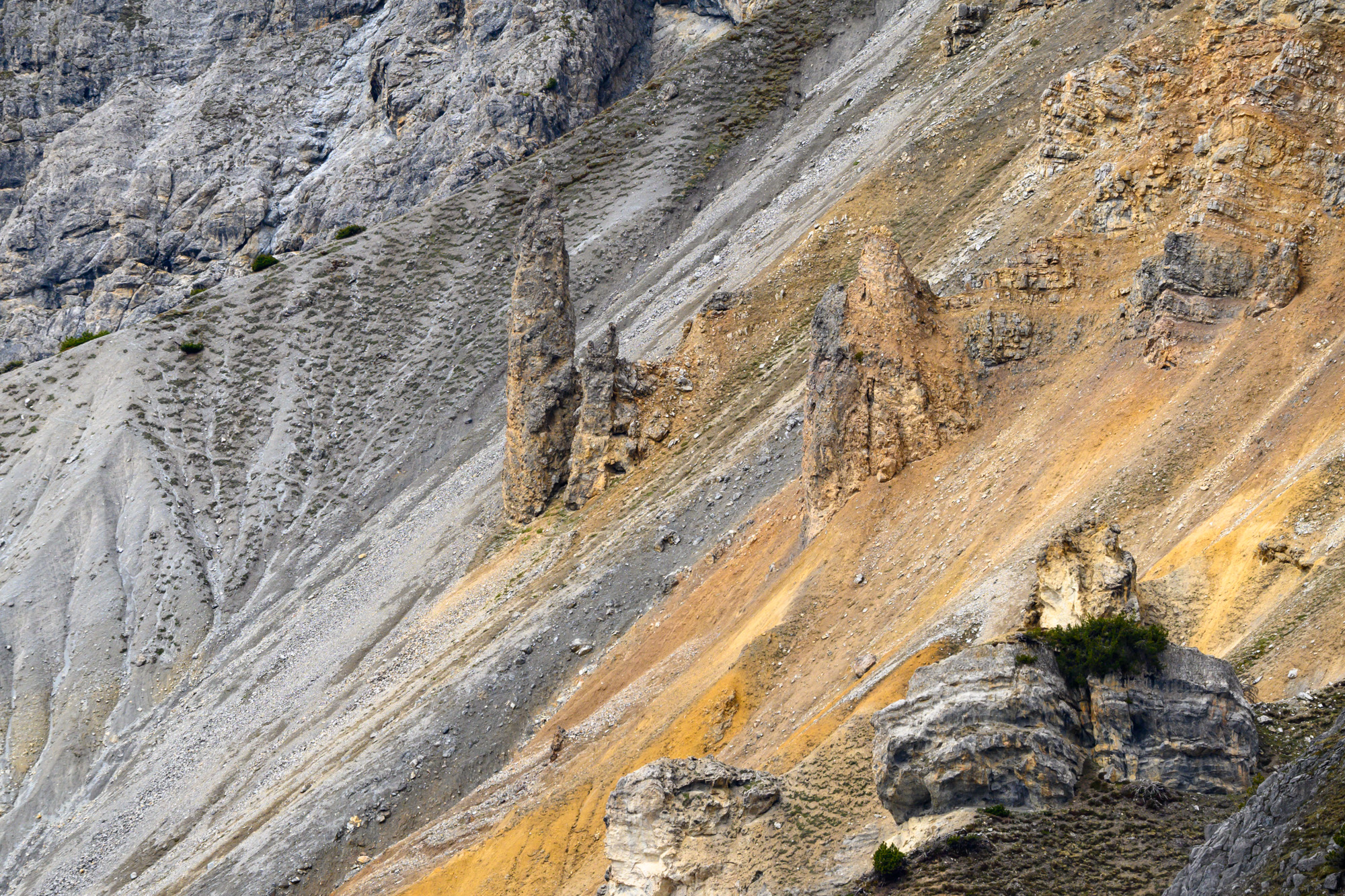


Rauhwacke
This is full of holes – like a sponge! And it’s very rough! And it’s very rough!
The stone is called cellular dolomite or Rauhwacke.
That’s a strange name.
This rock is a mixture of dolomite and gypsum. What we see here is only the dolomite – with holes. The gypsum, which is soluble in water, has been washed out.
The holes make the rauhwacke very permeable, which is why the sources of lots of springs are found in this type of rock. It’s not good when workers constructing tunnels come across this rock as it’s usually saturated with water and when the machines bore into it, the water is released under high pressure into the tunnel.
I can see lots of small stone debris.
Rauhwacke really shows what great activity there must have been at the time of its creation.
Because gypsum is easily deformed, the rocks that existed in the layers where therewas a lot of gypsumwould have been pushedaround over each other, withthe gypsum acting like alubricant. With all thismovement the rocks werebroken up into little pieces.
So the rauhwacke really had to go through a lot!
We find yellow-coloured bands of rauhwacke in the National Park, at Margunet for instance.